Statistics
Enrollment: 565
Average Undergrad GPA: 3.20
Regular Application Deadline: 07/15
Rolling Admission: Yes
Campus Surrondings: Village
Student Faculty Ratio: 10:1
Programs & Curriculum
Weekend Classes Available: No
Evening Classes Available: Yes
Total Faculty: 55
Part Time Faculty: 10
Full Time Faculty: 45
Scholarships & Financial Aid
Financial Aid Deadline: 08/01
Students Receiving Some Aid: 70%
School Says - General InformationA comprehensive and scholarly environment. A blend of rich tradition and advanced technologies. A community of individuals—unique in their strengths, united in their goal to succeed—and to lead. These are some of the ingredients driving our dynamic, interactive, personalized approach to education.
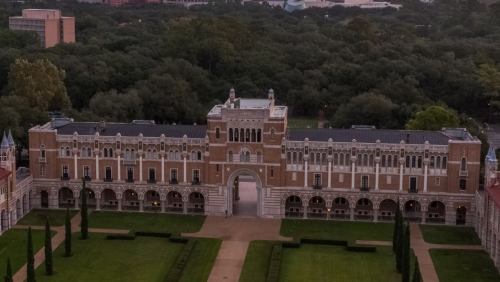
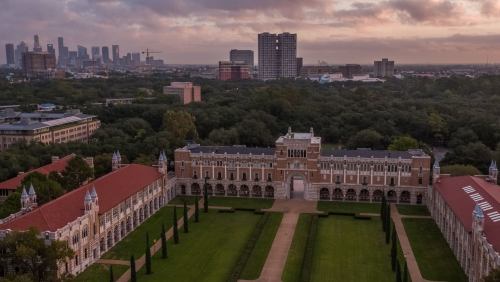
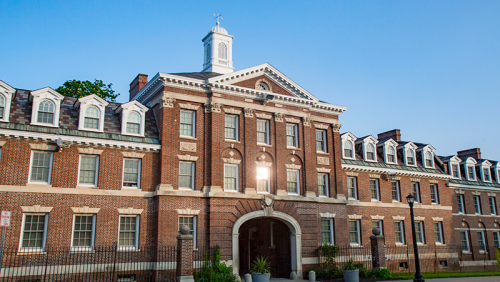
While the centerpiece of Monmouth University's 156-acre campus is the magnificent Woodrow Wilson Hall, a National Historic Landmark, the present moment here is nothing short of exhilarating. The future is wide open, yours for the making. Become the leader who defines the present, impacts the future, respects the past.
There is no substitute for seeing things for yourself. Experience our environment, meet our faculty, absorb the stately architecture of Wilson Hall—and discover why you belong here.
Prepare for a visit to Monmouth University by taking our online virtual tour, where you will become familiar with the campus and the surrounding communities. Then plan to visit us in person. We offer graduate information sessions in the evenings, library visits, and other opportunities to meet with admission representatives. Check the Web site for details: www.monmouth.edu/visit.
We look forward to your arrival at Monmouth University. Here you can develop your strengths, energize your life, define your future. Monmouth University. Where leaders look forward.
School Says - Student BodyApproximately 6,000 undergraduate and graduate students are members of the Monmouth University community. Our students come from 29 states and 23 countries. With an average class size of 22 students, and a 15:1 student to faculty ratio, you do not get lost in a crowd.
Our graduate students are a blend of working professionals, and recent graduates of undergraduate programs who have chosen to move directly into graduate study.
School Says - AcademicsThe Graduate School administers the graduate programs through five academic schools: School of Business Administration, School of Education, the Wayne D. McMurray School of Humanities and Social Sciences, the Marjorie K. Unterberg School of Nursing and Health Studies, and the School of Science, Technology and Engineering.
The graduate school degree programs are designed to meet the educational needs of post-baccalaureate students who wish to acquire advanced knowledge and skills in their chosen fields of study and to engage in research and other scholarly activities. Classes are offered year-round, scheduled predominantly in the evening. The exception is the MSW program, which offers a full-time program during the day and part-time in the evening.
The University is licensed by the New Jersey Commission on Higher Education and accredited by the Middle States Association of Colleges and Schools. In addition, the School of Business Administration is accredited by the international AACSB—the Association to Advance Collegiate Schools of Business; the software engineering program is accredited by the Engineering Accreditation Commission of the Accreditation Board for Engineering and Technology (ABET); the nursing program is accredited by the Commission on Collegiate Nursing Education (CCNE) and the New Jersey State Board of Nursing; and the undergraduate BSW and graduate MSW social work programs are accredited by the Council on Social Work Education (CSWE).
School of Business Administration
Master of Business Administration (MBA), with optional tracks in Accounting, Finance, or Real Estate
Master of Business Administration with Concentration in Healthcare Management (MBA)
Post-MBA Certificates in Healthcare Management or Accounting
School of Education
Master of Arts in Teaching (MAT), Initial Certification, with tracks in Early Childhood (P-3), Elementary (K-5), Middle School (K-5 plus middle school endorsement), and Secondary (9-12)
Master of Education (MEd)
Master of Science in Education (MSEd), Educational Counseling
Master of Science in Education (MSEd), Principal
Master of Science in Education (MSEd), Reading Specialist
Master of Science in Education (MSEd), Special Education
Five-Year BSEd and MSEd Reading Specialist
EDUCATION ENDORSEMENT CERTIFICATION PROGRAMS
Early Childhood
ESL
Post-Master's Certification Endorsement: Counseling
Post-Master's Certification Endorsement: Principal
Post-Master's Certification Endorsement: Learning Disabilities Teacher-Consultant
Post-Master's Certification Endorsement: Reading Specialist
Substance Awareness Coordinator
Supervisor
Teacher of Students with Disabilities
School of Humanities and Social Sciences
Master of Arts in Corporate and Public Communication (MA)
COMMUNICATION CERTIFICATE PROGRAMS
Public Relations Specialist
Media Studies Specialist
Human Resources Communication Specialist
Master of Arts in Criminal Justice (MA)
CRIMINAL JUSTICE CERTIFICATE PROGRAM
Criminal Justice Administration
Master of Arts in English (MA)
Master of Arts in History (MA)
Master of Arts in History (MA), European History Track
Master of Arts in History (MA), World History Track
Master of Arts in History (MA), History of the U.S. Track
Master of Arts in Liberal Arts (MA), Liberal Studies Track
Master of Arts in Liberal Arts (MA), Professional Studies Track
Master of Arts in Public Policy (MA)
Master of Arts in Psychological Counseling (MA)
Master of Science in Professional Counseling (MS)
PSYCHOLOGICAL COUNSELING CERTIFICATE PROGRAM
Professional Counseling (post-master's)
Master of Social Work (MSW), International and Community Development Track
Master of Social Work (MSW), Practice with Families and Children Track
SOCIAL WORK CERTIFICATE PROGRAM
Play Therapy
School of Nursing and Health Studies
Master of Science in Nursing (MSN) Advanced Practice Nursing, Adult Track
Master of Science in Nursing (MSN) Advanced Practice Nursing, Adult Psychiatric and Mental Health Track
Master of Science in Nursing (MSN) Advanced Practice Nursing, Family Track
Master of Science in Nursing (MSN) Advanced Practice Nursing, Administration Track
Master of Science in Nursing (MSN), School Nursing Track
Master of Science in Nursing (MSN), Nursing Education Track
Master of Science in Nursing (MSN), Forensic Nursing Track
NURSING CERTIFICATE PROGRAMS
Advanced Practice Nursing: Adult Nurse Practitioner (post-master's)
Advanced Practice Nursing: Adult Psychiatric and Mental Health (post-master's)
Advanced Practice Nursing: Family Nurse Practitioner (post-master's)
Advanced Practice Nursing: Nurse Administrator (post-master's)
Forensic Nursing
Nursing Education (post-master's)
School Nurse
School Nurse (Non-Instructional)
School of Science, Technology and Engineering
Master of Science in Computer Science (MS), Telecommunications Track
Master of Science in Computer Science (MS), Computer Networks Track
Master of Science in Computer Science (MS), Intelligent Information Systems Track
COMPUTER SCIENCE CERTIFICATE PROGRAM
Software Systems Design and Development
Master of Science in Software Engineering (MS), with optional tracks in Organizational Management, Telecommunications, Embedded Systems, Information Management, Management of Software Technology, or Thesis
SOFTWARE ENGINEERING CERTIFICATE PROGRAMS
Software Development
Software Engineering
The graduate faculty provides the core of instruction in the graduate school at Monmouth University. Recognized for their scholarly achievements by peers in their fields, the members of the faculty provide a challenging classroom environment. The faculty brings insight from research and professional experience into the classroom. Graduate students are drawn into the ongoing, creative work of the faculty through classroom demonstration, as research assistants, and through attendance at professional meetings. Faculty members also serve as advisors and mentors to students, in many cases not only during the course of their studies but also after they graduate from the University. Working directly with senior faculty who are engaged in research is a key element in graduate-level study.
School Says - AdmissionsGraduates of colleges of recognized standing, whose records show evidence of ability to do graduate work, may apply for admission. Selection for all programs is based in the student's ability to do graduate work of high quality as shown by the distinction of the undergraduate record, particularly in the major, scores on appropriate admission tests, and/or other supporting documentation where required. Each program has its own set of admission requirements and all admission decisions are approved by the program director of the department in which the student plans to earn a graduate degree. Information about admission requirements for specific programs is available online at www.monmouth.edu/admission/adm_graduate.asp.
The deadline for application for the fall semester is July 15; for the spring semester is November 15; and for summer sessions, the deadline is May 1. Qualified applicants are given consideration after the deadline on a space-available basis. NOTE: Applications for the fall term are only accepted for the MSW program until March 15, and for the Corporate and Public Communication program until June 15.
School Says - Campus LifeThe University is located in the safe residential town of West Long Branch, New Jersey—an attractive community near the Atlantic Ocean, about an hour and a half from the metropolitan attractions of New York City and Philadelphia. Monmouth enjoys the advantage of proximity, within its home county, to many high-technology firms and financial institutions, and a thriving business-industrial sector. These provide employment possibilities for Monmouth University graduates, and provide opportunities for experiential education. The University's 156-acre campus, considered one of the most beautiful in New Jersey, includes among more than 50 buildings a harmonious blend of historic and contemporary architectural styles.
Major construction and renovation projects have transformed the University into a state-of-the-art campus. These include a pedestrian mall, an underpass that connects the north end of the campus with the main campus, new residence halls, and two new academic buildings; Robert E. McAllan Hall and the Jules L. Plangere Jr. Center for the Communication and Instructional Technology, featuring classrooms, offices, and communication facilities. A community-centered Web site and innovative instructional technology plan have also been implemented.
School Says - Cost AidStudents may qualify for federal financial aid by filing the Free Application for Federal Student Aid (FAFSA), available online at www.fafsa.ed.gov.
The cost per credit for graduate classes during the 2006–2007 academic year is $673. Additional information about expenses for 2006–2007 is available online at www.monmouth.edu/admission/financialaid/pay/tuitionfees/gtuitionfees.asp.
Academic scholarships are available to graduate students in selected majors. Awards are made to students who earned a 3.0 or better cumulative grade point average while completing their undergraduate or post-baccalaureate degree. Graduate fellowships are renewable for each semester of enrollment at Monmouth, assuming you have maintained a cumulative grade point average of 3.0 or better.
Award values are also based on the total number of credits taken each semester and range from $160 to $3,920 per semester. For example, a student with a 3.0 grade point average taking six credits will typically receive $630 per semester.
Request a Brochure
More at PrincetonReview.com
College Search
Find information on thousands of colleges and universities. Access undergraduate, graduate, business, law, and medical school profiles.